


“Lean in. Be curious. And build with people who share your values.” -Ashley Sherwin, Giving Credit
Ashley Sherwin didn’t set out to build a fintech company.
In fact, for most of her career, she wasn’t in the traditional startup ecosystem. She was operating in a very different world: nonprofits, community organizations, and national social impact initiatives focused on financial inclusion and economic mobility.
Sherwin’s work sat closest to the people most often left out of financial systems: families navigating everyday financial realities without access to traditional tools, not venture-backed founders or institutional investors.
During this time in her career, the fintech industry was booming, promising innovation, access, and efficiency. But for all its growth, much of it still relied on the same underlying infrastructure: credit systems that excluded millions of people from the start.
That disconnect became harder to ignore. The problem wasn’t that people lacked financial behavior, it was that the system wasn’t designed to recognize it.
Like many founders, Sherwin’s path to entrepreneurship wasn’t linear. It was shaped by years of proximity to the problem, a deep understanding of the communities most impacted, and a growing realization that incremental change within existing systems wouldn’t be enough.
Today, as the co-founder of Giving Credit, Ashley Sherwin is working to reimagine how credit works in America, starting with the financial behaviors that have been hiding in plain sight all along.
Sherwin’s professional journey began in the nonprofit sector, where she spent over two decades working across organizations focused on youth development, economic mobility, and financial health.
“I’ve spent my whole career in the social impact space,” Sherwin said. “I always knew I wanted to do something that created impact. I just didn’t know exactly what that would look like.”
In the U.S. alone, the nonprofit sector employs more than 12 million people (roughly 10% of the private workforce) yet it remains largely disconnected from the venture-backed innovation economy. At the same time, the issues nonprofits are working to address, like income inequality and financial access, continue to widen. According to the Federal Reserve, nearly 40% of Americans would struggle to cover a $400 emergency expense, highlighting just how fragile financial stability remains for millions of households.
Early on in her career, Sherwin worked in youth substance abuse prevention at a national nonprofit. Over time, her roles expanded into leadership positions focused on revenue generation, partnerships, and operations, eventually raising hundreds of millions of dollars across organizations. As her career progressed, she began to notice a recurring pattern.
“I saw a disconnect between those that have and those that don’t, and the power dynamics that exist there,” Sherwin said.
That disconnect wasn’t just anecdotal, it was systemic. Despite decades of policy efforts, wealth inequality in the U.S. continues to grow, with the top 10% of households holding the vast majority of wealth, while millions remain excluded from basic financial tools. Roughly 7 million Americans are considered “credit invisible” or have insufficient credit history, according to the Consumer Financial Protection Bureau, effectively locking them out of mainstream financial systems like loans, housing, and even certain jobs.
That realization pushed Sherwin deeper into the world of financial inclusion, specifically to understand how systems could be redesigned to better serve low- and moderate-income communities.
It also led her back to school, where she earned an MBA focused on social impact management, intentionally bridging the gap between mission-driven work and business strategy.
For Sherwin, the goal wasn’t just to operate within broken systems, it was to understand how to rebuild them.
The idea for Giving Credit didn’t come from a brainstorm; it came from observation.
Sherwin and her co-founder, David Henderson, were previously both part of the leadership team at a non-profit fintech company, where their work eventually led them to see something most financial institutions overlooked.
“We started to see these hidden banking networks in communities,” Sherwin explained. “People were constantly lending and borrowing from each other.”
That insight runs counter to how traditional finance is designed; they identified that millions of Americans were operating on the margins of the formal credit system.
Credit invisible adults in the U.S. or those who have insufficient credit history have a limited ability to access mainstream financial products. At the same time, informal financial activity is both widespread and substantial. Research from the Federal Reserve System and other institutions shows that a significant share of households, especially low- and moderate-income families, regularly rely on friends and family for financial support, whether through small loans, shared expenses, or mutual aid.
This points to a massive, largely unrecognized market. Estimates suggest that over $200 billion in peer-to-peer lending circulates informally across U.S. communities, with money being exchanged based on trust, relationships, and social accountability rather than formal underwriting.
And yet, none of that activity is recognized by traditional credit systems.
“Every day, people are proving they’re creditworthy,” Sherwin said. “But the system just doesn’t see it.”
That gap became the foundation for Giving Credit.
Giving Credit is what Sherwin describes as a “community finance credit reporting agency.” It’s a platform that allows people to document and build credit from the financial behaviors they’re already engaging in, like lending to a friend, splitting rent, or supporting family members.
The concept challenges a deeply ingrained assumption in traditional finance: that creditworthiness must be determined exclusively through formal institutions like banks, credit cards, and loan providers. For millions of Americans, financial life has never operated that neatly.
According to the Federal Reserve System, nearly 37% of adults would struggle to cover a $400 emergency expense using cash or savings, underscoring how frequently people rely on informal support systems to navigate everyday financial realities.
Giving Credit is built around the trust-based systems that already exists within communities.
“There’s a misconception that this kind of lending is risky or informal in a negative way,” Sherwin said. “But the reality is, these systems are incredibly resilient because they’re built on relationships.”
In many ways, Giving Credit is attempting to formalize something communities have practiced for generations: mutual aid, shared responsibility, and trust-based finance.

Like many founders, Sherwin’s journey hasn’t just been professionally challenging; it’s been deeply personal.
Within her first year as a full-time founder, she experienced loss and challenges within her family, all while simultaneously raising two young children.
“The company didn’t slow down,” Sherwin said. “Life was happening at the same time.”
Her experience reflects a reality that often goes unspoken in startup culture. While entrepreneurship is frequently associated with flexibility and autonomy, founders also experience significantly higher levels of stress, uncertainty, and emotional strain than traditional workers.
One of the ways founders can find refuge from stress and the day-to-day demands on building a company is building with community. Sherwin participated in the 2024 cohort of Visible Hands’ VHBOS program, the firm’s fellowship for Boston-based founders scaling high-growth startups.
Throughout her time in VHBOS, Sherwin was able to work alongside founders who understood what it’s like to build in today’s climate, and received hands-on support from Visible Hands’ team, working closely with VH Co-Founder and Investor Daniel Acheampong.
Acheampong praised Sherwin for her entrepreneurial prowess, and was impressed with her deep knowledge for the problem she was solving, her customers, and her dedication to forming the right solution to fix it, despite how stressful the journey could be to get there.
“Ashley is an exceptional founder,” Acheampong said. “She has a deep financial domain expertise, personal proximity to the problem, and steady execution. It's a joy to work with Ashley.”
Sherwin recalls that while there were moments where the weight of it all felt overwhelming, in many ways, building Giving Credit also became a source of stability.
“It gave me something positive to focus on,” she said. “Something that felt like forward momentum.”
Through it all, her co-founder relationship proved critical. That sense of partnership became especially important during periods where personal grief and company-building existed simultaneously, something many founders quietly navigate behind the scenes.
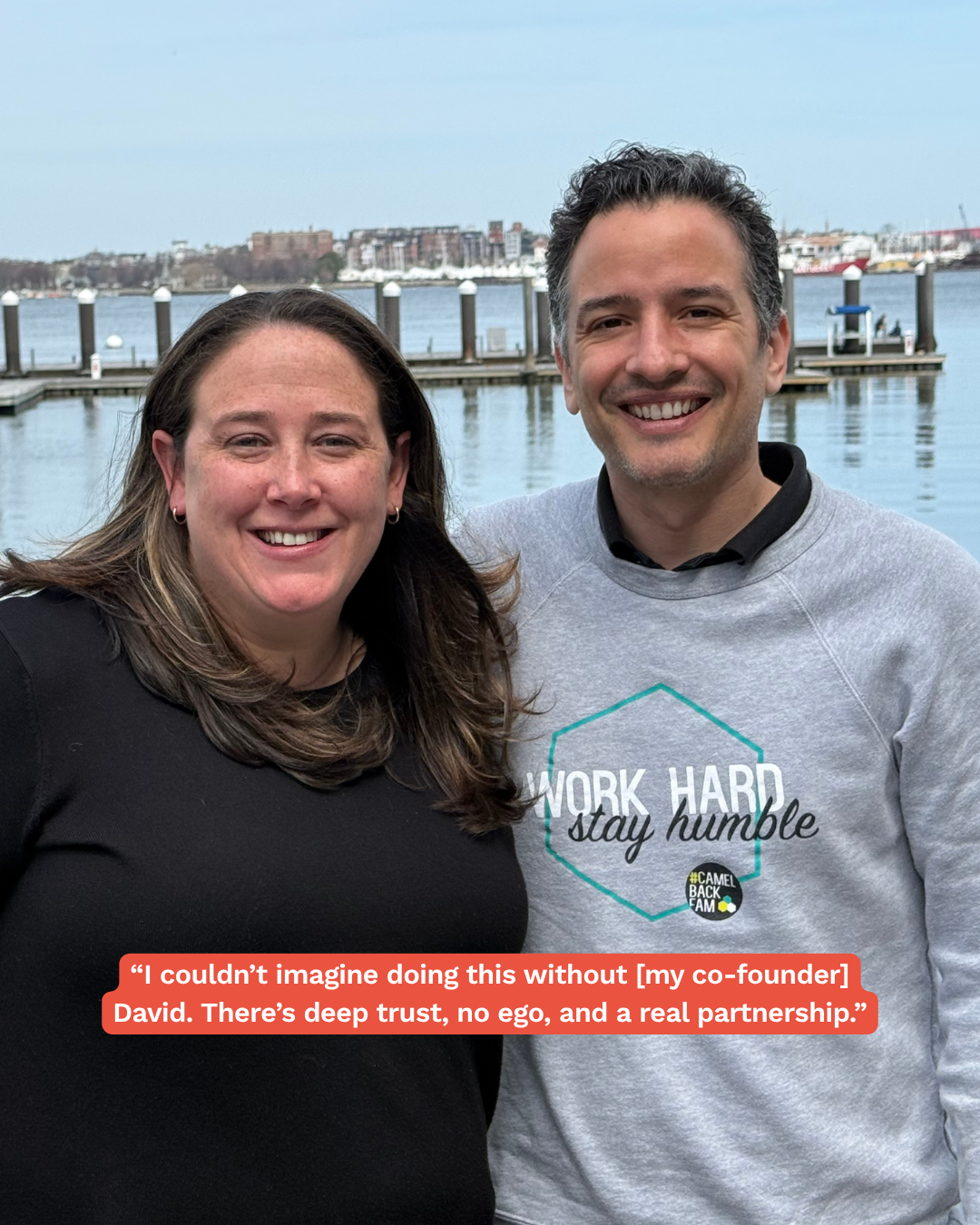
“I couldn’t imagine doing this without David,” Sherwin said. “There’s deep trust, no ego, and a real partnership.”
The ability to lean on her team ultimately helped Sherwin find her own definition of balance among all the different hats she wears, professionally and personally. To her, balance doesn’t look like clean separation between work and life, but rather integration. Her kids are often nearby while she works. Whiteboard sessions happen at the dining room table, and late nights blur into family time.
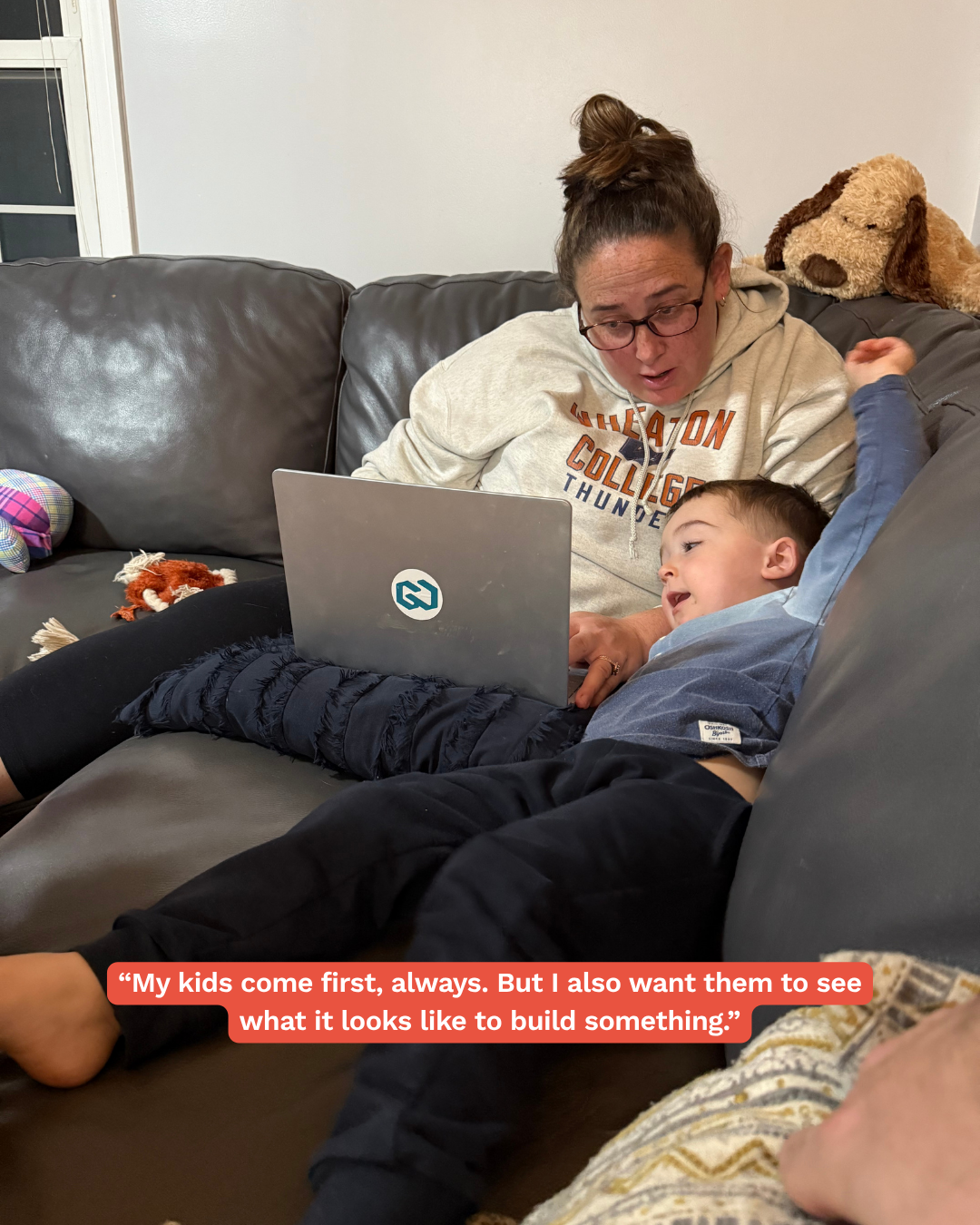
“My kids come first, always,” Sherwin said. “But I also want them to see what it looks like to build something.”
That reality reflects a growing shift in how many modern founders, particularly women founders and parents, approach entrepreneurship. Rather than striving for perfect compartmentalization, many are building companies alongside caregiving responsibilities in real time.
According to the Kauffman Foundation, entrepreneurship among parents and caregivers has continued to rise over the past decade, even as access to childcare and economic pressures remain major barriers.
Rather than viewing parenthood as a limitation, Sherwin sees it as grounding.
“We’re building a system that should work for families, not just individuals,” she said.
That perspective shapes not only her leadership style, but the broader philosophy behind Giving Credit itself.
Traditional financial systems often evaluate people in isolation, as individuals detached from family structures, caregiving dynamics, or community support systems. But Sherwin believes financial health is inherently relational.
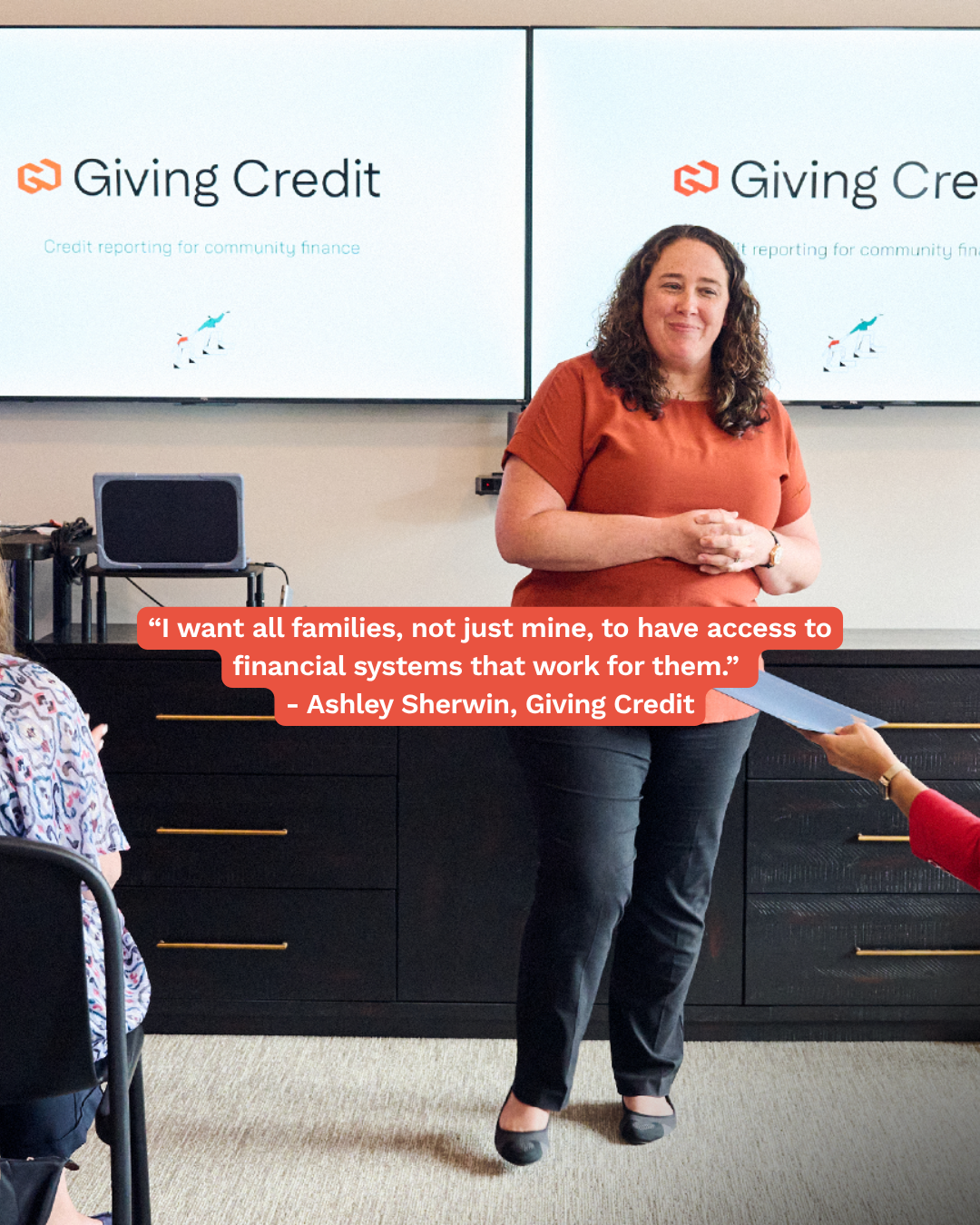
“I want all families, not just mine, to have access to financial systems that work for them,” she said.
For her children, Giving Credit may still look like “mom sitting at the computer too long.” But for Sherwin, the work represents something bigger: creating a future where more families can access opportunity, stability, and trust within the financial system.
Since launching, Giving Credit has reached significant traction:
But for Sherwin, the next phase is clear: scale.
“We need to prove that what feels intuitive, that repaying a community loan signals creditworthiness, is actually predictive,” she said.
That means growing both users and data, while building partnerships across financial institutions and community organizations.
And for founders watching her journey, especially those coming from nontraditional backgrounds, Sherwin’s advice is simple:
“Lean in. Be curious. And build with people who share your values.”
Because sometimes, the most transformative companies aren’t built by insiders. They’re built by people close enough to the problem to see what everyone else has missed.
At its core, Giving Credit isn’t just a product; it’s an attempt to build an entirely new layer of financial infrastructure. One that recognizes behavior that’s been ignored for decades.
Giving Credit is the community finance credit reporting agency.
💼 Learn more: http://givingcredit.org/
For founders looking to find their own balance while building in Boston, applications are open now through July 10, 2026 for Visible Hands’ VHBOS Fellowship program. Learn more and apply today here.


