

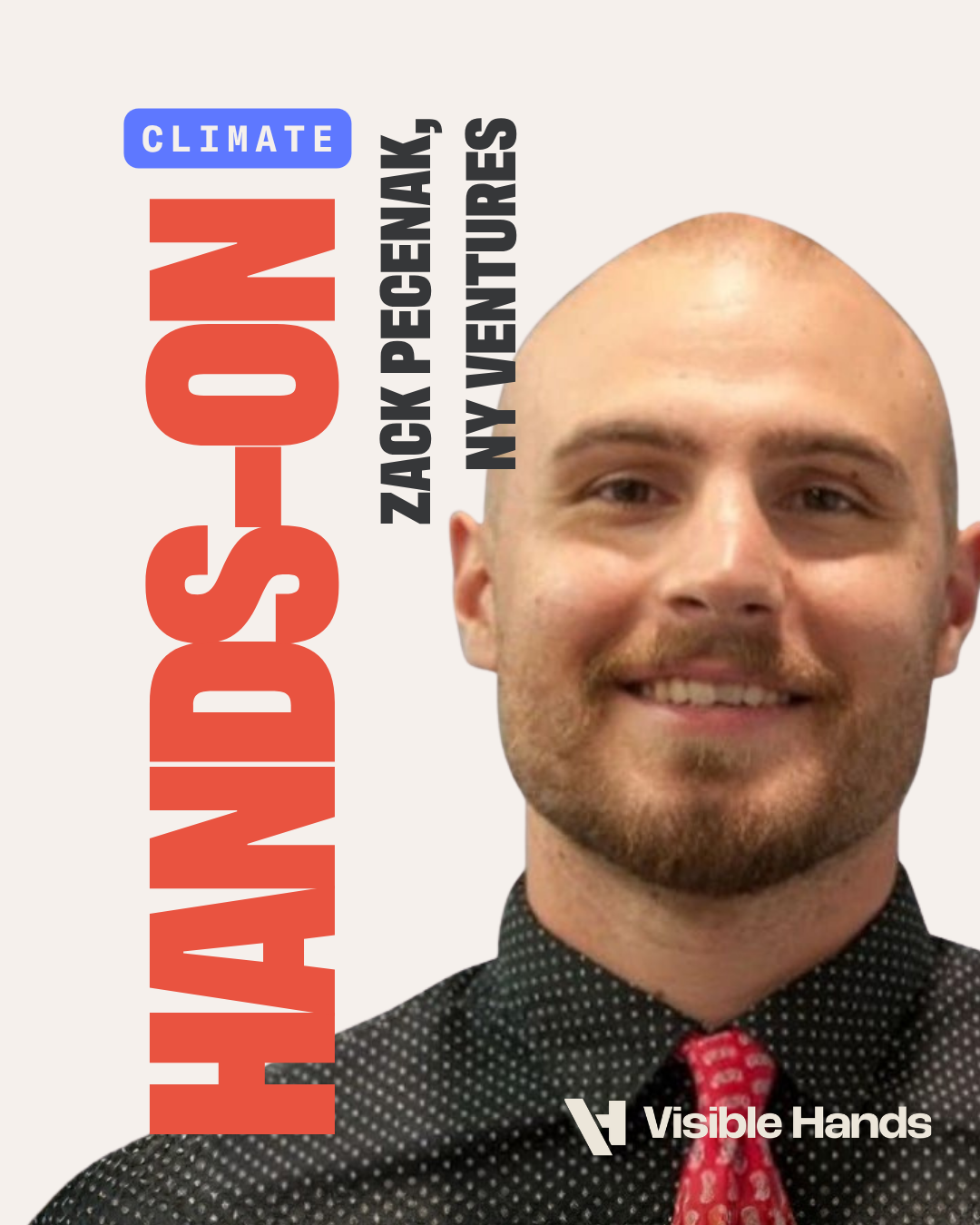
This interview highlights Zack Pecenak, Director of the NYS Innovation Venture Capital Fund at NY Ventures, New York State's venture capital investment arm within Empire State Development. NY Ventures invests broadly in emerging technologies that can face challenges reaching the commercial market, as well as in overlooked founders and underserved regions. Zack's primary investment interests include climate and energy, agriculture, quantum technology, and biodiversity and conservation technology. Prior to joining Empire State Development, Zack was a founder and early employee at West Coast-based climate and energy startups. He holds a Ph.D. from the University of California, San Diego, where he pioneered methods to solve electric power grid challenges more efficiently.
Q: There's an ongoing debate about whether climate investing requires a fundamentally different model than traditional venture i.e. longer time horizons, different return profiles, more patient capital structures. Where do you land on that?
A: Generally, investments in hard tech come with the expectation that returns will take longer, require more capex, and carry lower margins than a traditional software business. That said, these businesses tend to be more defensible, and when they work, they are very durable. Across every hard tech vertical, they also face a risk that non–hard tech businesses don't: scaling risk. Landing a first pilot is typically a multiyear effort. Buyers of these technologies are industrial in scale and do not move fast. Assuming you can agree on a scope — and that your internal champion stays employed — you then need to raise millions to fund that single project. For most investors, this risk profile is a bar too high, because it becomes all or nothing. Most will want extensive lab data and hours with your potential customers before committing. Needless to say, the pool of investors willing to do that is incredibly small, and there is only so much capital in the system to support these projects.
For that reason, I do think alternative forms of capital matter. I've given a lot of thought to what works best, and the simple answer is that outside of government grants, there isn't much capital available to companies in the early part of the J-curve, before profitability. At ESD, and with partners like NYSERDA, that's often why we fund innovation "infrastructure" projects — access to university resources, shared equipment, business support, or customer connections. These are non-dilutive resources that the government can efficiently democratize across many industries while still benefiting individual companies.
Q: What sectors or technologies within climate are you most excited about right now that you feel the market is still underpricing or under-funding?
A: We are still stringing electric wires on poles even as increasingly severe storms threaten to knock them down, underscoring the need for innovations that can make burying power lines a more cost-effective alternative. There is also an opportunity to move beyond oil-based transformers, which can limit the integration of renewable energy, and toward solid-state power electronics. Advances in parallel computing, optimization and quantum computing could further transform the grid by reducing the approximations currently required to manage and control it. There is tremendous room for innovation — and it's where NY Ventures spends much of its time.
Beyond that, resilience and supply chain remain critical places for investment. If a product can be produced from waste reliably such that an industrial customer can offset international supply shocks, that is durable and increasingly important. New York's industrial base and university research pipeline make it a strong place to build those companies, which is part of why we invest here.
Q: How do you think about the role of policy and regulation in your investment decisions? Do you invest with or against the policy cycle? Has that calculus shifted in recent years?
A: It's hard to ignore titanic shifts, but it's critical to take the big-picture view and understand where the current is headed, not just what the waves are doing. Some things are true regardless of policy, and as they unfold, businesses will pay to solve for them. If a business is reliant on any single policy, that's an asymmetric risk. I look for a strong underlying business case first, with policy as an accelerant — which is exactly how we think about our own programs at NY Ventures. The best use of public capital is to move a fundamentally sound company faster than it could move on its own.
Q: What do you look for in climate founders that is distinct from what you'd look for in a founder building in something like AI, SaaS, or consumer? Is there a profile that tends to succeed here?
A: In a few words: patience, technical rigor, empathy, ambition and focus. Climate businesses are not always flashy, so founders need the patience and technical depth to build for the long term while still thinking big. At the same time, having a strong public presence is critical, particularly when the underlying technology or business may not immediately capture attention on its own.
Q: What's your contrarian view or nonobvious insight about where climate tech is headed in the next five years?
A: Reuse is going to become increasingly important. Solar panels and batteries are often discarded with significant useful life remaining. Food waste is sent to landfills at a cost, while useful chemicals are released from industrial processes into the atmosphere. At the same time, the raw materials needed to produce new products are often shipped across the globe.
Founders who can find ways to recover that value, turn waste into useful products and sell them below prevailing market prices will be building businesses with a durable advantage.
Learn more about NY Ventures and its investment portfolio at esd.ny.gov.


